

"Sex work is work"
On solidarity, not just semantics

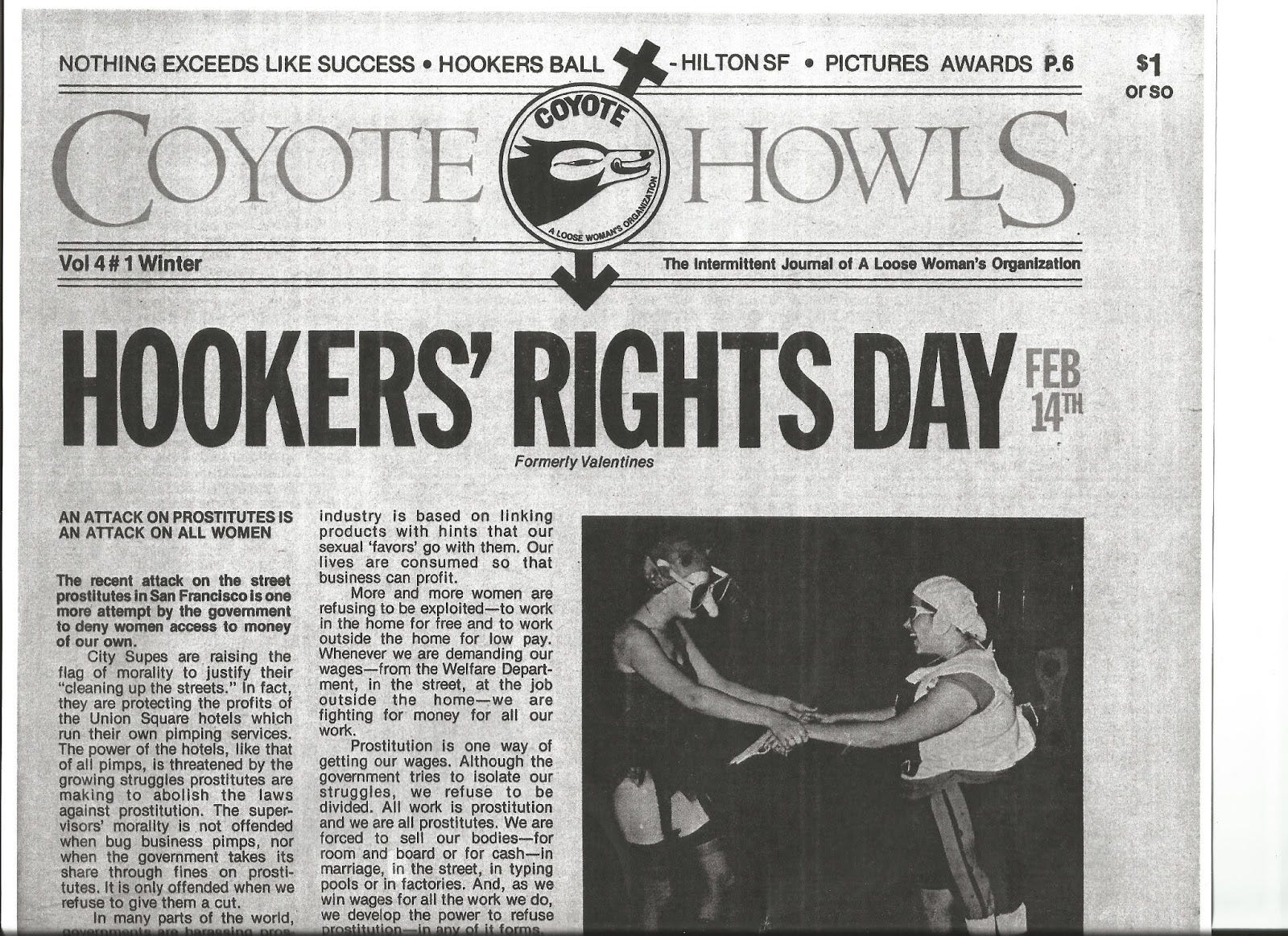
You’ve probably seen it on a protest sign, emblazoned on a t-shirt, or maybe on a cheeky sticker plastered to someone’s water bottle or laptop. You’ve probably heard other liberals or leftists say it when discussing erotic labour. You might think you know what it means, but you might be wrong.
Carol Leigh, a COYOTE (Call Off Your Old Tired Ethics) member and full service worker also known as Scarlot Harlot, coined the term ‘sex work’ in the 1980s to avoid the ‘connotations of shame, unworthiness or wrongdoing’ of the word prostitute and assert ‘an alternative framing that is ironically both a radical sexual identity … and a normalization of prostitutes as “service workers” and “care-giving professionals”1.
One would be forgiven for thinking that “sex work is work” is therefore about normalization: treating sex work as any other form of labour. This more liberal interpretation is well-intentioned but actually undermines the argument. It requires pretending that sex work isn’t uniquely precarious, uniquely stigmatized, and uniquely dangerous, which is both empirically false and politically counterproductive. You can’t build a labour rights movement on a foundation of “actually, everything is fine.” That being said, we can both reject this framing of normalization without rejecting normalization as a goal. No one should feel ashamed for performing paid sexual labour. However, this popular interpretation is, in fact, a drift from the original meaning, not an evolution of it. As Sanders, O’neill, and Pitcher discuss in their book Prostitution: Sex Work, Policy and Politics, this new terminology of “sex work” solidified the growing sex workers’ rights movement’s demand for recognition as workers entitled to labour rights.
The reality is that sex work is different from other forms of labour. The patriarchal structure of the industry, the gendered power dynamics, and the unique intersection of stigma and misogyny all form a complicated nexus. No other industry presents this specific confluence of oppression and criminalization, or produces the same levels of violence against its workers.
It is specifically on the issue of violence that academic Julia O’Connell Davidson2 draws out the reasons why sex work is not like other occupations. She points out that there are other professionals, such as plumbers, sales personnel, and estate agents who enter houses alone to meet strangers, and occasionally we hear of violence or even fatalities. Only in sex work is it prevalent that if a customer is unhappy, he will beat, rape or murder the service provider because ‘there is no popular moral doctrine which tolerates hostility towards “dirty plumbers,” only “dirty whores.”3
Similarly, I have never had to screen my corporate consulting clients for safety or cross-reference their names against a database of blacklisted clients. (It’s worth noting, however, that most women working in a corporate workplace have encountered and perhaps even relied upon informal whisper networks to stay safe from known sexual harassers at work.)
In this way, the dilution of “sex work is work” risks masking some of those very real dangers for women and femme-presenting people newly entering the industry. A couple of years ago, someone reached out to me asking for advice on how to become a professional Dominatrix. My first question was, “Why?” As someone who loves the work I do, I know exactly why someone might want to become a pro Domme. The elevated rates of job satisfaction among professional Dominatrices have actually been studied4. We are situated on the upper rungs of a socially constructed (and deeply problematic) “whorearchy” for a reason5. The high earning potential, the flexibility, the autonomy, the breadth of exciting skills that can be developed and mastered, the relative safety compared to other in-person sex work, the relative privilege compared to other sex workers, the undeniably cool latex and leather outfits (!) all make it an incredibly attractive profession from the outside looking in. However, this person’s response revealed a not-uncommon naivete. When I then asked them if they were prepared to lose relationships with friends and family due to stigma, have their current employer find out, be refused tenancy as a renter, be barred from entry to the United States when travelling across the border, lose access to their bank account, risk encountering violent clients… all of a sudden the cool, fun job seemed less cool and less fun.
The point here isn’t that SW is too risky an industry for women to enter—it’s that workers in any industry without adequate legal protections and peer support are more vulnerable. Again, the solution is better protections and more honest information, not discouraging entry.
The slogan “sex work is work” is also sometimes misinterpreted as a mantra for women’s empowerment. However, the binary of exploitation vs empowerment is, at this point, outdated, inaccurate, and a distraction from the actual conversation. No job is truly empowering under capitalism. I never felt empowered or liberated commuting to my desk job, sitting under fluorescent lights, creating Gantt charts. So the question isn’t whether SW is empowering, but whether workers have protections, agency, and rights.
Now, one can, and many of us SWers do, view sex work as a way of exploiting an already exploitative system: if we are forced to navigate misogynistic, patriarchal systems in nearly every sphere of our lives (from the unpaid household labour we disproportionately take on in hetero partnerships, to the additional non-promotable “office housekeeping” tasks women take on in corporate workplaces, to the unpaid emotional labour performed… everywhere) why not profit from it through paid erotic labour? This is not to encourage anyone to enter the sex industry either, but rather to examine some of the reasons why one might.
So if “sex work is work” isn’t about normalization, and it isn’t about empowerment, what is it actually about? Stripping the slogan of its liberal accretions leaves us with something more useful and more radical: a straightforward demand for the same legal protections afforded to every other worker. Not because sex work is just like other work, but because sex workers deserve the same protections as other workers, and we need them more urgently due to the unique nature and positionality of our work.
The legal protections we are fighting for look very different depending on the kind of erotic labour performed. What makes sense for a stripper might not make sense for a full-service worker. Organizations like the Canadian Alliance for Sex Work Law Reform (CASWLR), SWOP (Sex Workers Outreach Project), and the Global Network of Sex Work Projects (NSWP) all have clearly stated policy proposals, including employment standards protections (minimum wage, rest breaks, recourse for unfair employer practices) as well as occupational health and safety laws requiring workplace measures to reduce hazards, including violence. Of course, none of this can be achieved without full decriminalization.
As it relates to the fight for worker protections, one of the closest parallels we can draw from is domestic work, which includes nannies, house cleaners, and home care workers. As researcher Jo Bindman observed, the separation of sex work from other feminized, precarious service work “hides the commonality, the shared experience of exploitation, which links people in all such work. The distinction between ‘the prostitute’ and everyone else helps to perpetuate her exclusion from the ordinary rights which society offers to others, such as rights to freedom from violation at work, to a fair share of what she earns, or to leave her employer.”6 Like sex work, domestic work is also feminized, stigmatized, legally underprotected in many jurisdictions, performed in private spaces, often performed by migrant and other multiply marginalized women, and historically difficult to organize using standard labour organizing tactics. Domestic work is also frequently the site of abuse and labour exploitation due to its precarious nature.7
The work that the Domestic Workers’ Alliance has accomplished in the United States provides a particularly inspiring case study that sex work organizing can draw from. Due to the unique nature of domestic labour, where work is performed inside a client’s home and where health and safety standards cannot be made consistent, the DWA drafted a Domestic Workers’ Bill of Rights. This campaign not only asks for access to what many other workers take for granted, such as minimum wage and overtime protections, paid time off, and guaranteed breaks, but also recognizes that the needs of domestic labourers are indeed different from those of other workers because they do not operate in traditional workplaces. Instead of adopting the same protections as conventional workplaces, the Domestic Workers’ Bill of Rights focuses on what materially improves the working conditions of those who perform domestic work, as defined by those workers themselves. Sex workers can use this model to see how policy beyond decriminalization can continue to advance sex workers’ rights.8
Conversely, the important work that strippers across America have done to unionize can also serve as inspiration for other non-SWer contractors and gig workers. Strippers across the United States have successfully brought legal action against clubs for wage theft, unionization rights, and racial discrimination (suits that have historically been reserved for employees, not independent contractors)9. Strippers’ main legal weapon is the misclassification lawsuit. Former stripper, attorney, and sex worker rights advocate Caity Gwin, explains how it works: “attorneys representing a group of strippers prove we have been misclassified as independent contractors and then sue the club for unpaid back wages that we should have been paid as employees.”10 Importantly, strippers do not need to become employees to win these lawsuits (and, in fact, being reclassified as employees can be catastrophic, as seen in Dynamex Operations W. v. Superior Court (2018) in California11). It’s worth noting, however, that wage theft is far from the only issue strippers are fighting to rectify. Racial equity, safety, and ending coercive business dealings remain at the forefront. What strippers have demonstrated, however, is that an optimal balance can be found where they can be protected from blatant abuses and discrimination, while still maintaining autonomy, flexibility, and earning potential12.
Recently, strippers and sex workers in Montreal, organized by the Sex Work Autonomous Committee (Comité Autonome du Travail du Sexe in French, or CATS), went on strike during the Formula 1 Canadian Grand Prix weekend to protest poor working conditions and demand full labour rights. Key demands included an end to ‘bar fees’ that clubs charge strippers (clubs typically require dancers to pay anywhere between $15–100 simply to work) and a re-classification as employees, particularly for erotic massage workers who operate under what can only truthfully be described as an employer-employee relationship. CATS used traditional labour organizing tools like providing sex workers with easy-to-understand “how-to” guides on workplace organizing, held an assembly to gather grievances, followed by monthly workshops, which finally led to the call for a strike. Faced with a lack of legal protections, Montreal’s striking SWers exercised “the principle power that all workers possess: the power to withdraw their labour.”13
In this way, sex workers’ struggles are bound to the struggles of all workers, especially multiply marginalized workers. “Sex work is work” isn’t just for civilians to sympathize with SWers—it’s for everyone to understand that the legal and social frameworks that make sex work precarious are the same frameworks that make all informal, feminized, and marginalized labour precarious. When sex workers organize, we do it for everyone pushed to the margins of the labour market.
Sex work has a rich history of drawing on and contributing to these broader conversations about the labour rights of feminized work14. It’s therefore worth returning to Scarlot Harlot and to COYOTE. Founded in 1973, Call Off Your Old Tired Ethics wasn’t just a sex worker organization; it was a labour organization. A year after its inception, the group hosted the first-ever “National Hookers’ Convention” in San Francisco, gathering hundreds of sex workers to discuss their labour conditions, build community, and organize against exploitation. “Sex work is work” was never intended to be about reassurance. It was a demand to be included in the fight for workers’ rights. And as was so succinctly put by Kate D’Adamo in Sex Work Today: Erotic Labor in the Twenty-First Century: “In the face of poverty, sex workers work. In the face of marginalization, sex workers organize.”
Yours in solidarity,
MC
Elizabeth Bernstein, “What’s Wrong with Prostitution? What’s Right with Sex Work?” (Hastings Women’s Law Journal, 10(1) (1991), 91, as quoted in Teela Sanders, Maggie O’Neill, and Jane Pitcher, Prostitution: Sex Work, Policy and Politics (London: SAGE, 2009), 9.
O'Connell Davidson largely approaches SW from a critical feminist lens rather than an abolitionist position. While her work is skeptical of whether SWers truly have agency (which can border into SWERF-adjacent territory), her point here is structural rather than moral—the violence sex workers face is a product of stigma, not of the work itself.
Julia O’Connell Davidson, Prostitution, Power and Freedom (Cambridge: Polity Press, 1998), 64, quoted in Teela Sanders, Maggie O’Neill, and Jane Pitcher, Prostitution: Sex Work, Policy and Politics (London: SAGE, 2009), 11.
Tania G. Levey, “Dominating Pleasure: High Job Satisfaction among Professional Dominatrixes,” in Sex Work Today: Erotic Labor in the Twenty-First Century, ed. Barton, Brents, and Jones, (New York University Press, 2024), 163.
It is precisely because of my position at the more privileged end of this harmful hierarchy that I feel a particular obligation to advocate loudly for those who are not. Experiencing relative safety and having a platform are only meaningful if you use them on behalf of those who have less of both.
Jo Bindman, Redefining Prostitution as Sex Work on the International Agenda (London: Anti-Slavery International, 1997), 65, quoted in Teela Sanders, Maggie O’Neill, and Jane Pitcher, Prostitution: Sex Work, Policy and Politics (London: SAGE, 2009), 152. Note that Bindman writes from an abolitionist perspective, which I vehemently disagree with. Her point here, however, is structural: the exclusion of sex workers from standard labour protections is a political choice, not an inevitability, and one with measurable consequences for workers’ safety and rights.
For a comprehensive overview of labour conditions facing domestic workers in the United States, see Nadia Agarrat, "Domestic Workers in the United States: A Review of Labor Conditions," MA thesis, Rutgers University Graduate School — Camden, 2023, https://doi.org/10.7282/t3-ftxx-2567
A Labor-Rights Agenda for the Sex Industry by Kate D’Adamo, in Sex Work Today: Erotic Labor in the Twenty-First Century, ed. Barton, Brents, and Jones, (New York University Press, 2024), 271.
The New Legal Tools for Strippers by Caity Gwin, in Sex Work Today: Erotic Labor in the Twenty-First Century, ed. Barton, Brents, and Jones, (New York University Press, 2024), 275.
Ibid., 277.
Dynamex Operations West, Inc. v. Superior Court of Los Angeles, 4 Cal. 5th 903 (2018). The decision established a three-part "ABC test" to determine whether workers could be classified as independent contractors. While broadly beneficial for gig workers like rideshare drivers and delivery people, the ruling had significant unintended consequences for strippers in California. When Déjà Vu Services, the world's largest strip club operator, voluntarily reclassified its dancers as employees, many reported that clubs restructured compensation to dramatically reduce dancers’ earnings, with clubs taking larger cuts of dance sales, eliminating commissions on lower-tier earnings, and charging unexplained fees. One stripper reported taking home $460 on $1,000 in dance sales under the new model. Crucially, reclassification gave clubs more control over dancers, not less—the opposite of what employment protections are designed to achieve. This is precisely why sex worker-led organizations argue that standard employment frameworks must be adapted, not simply applied wholesale, to the specific conditions of erotic labour.
The New Legal Tools for Strippers by Caity Gwin, in Sex Work Today: Erotic Labor in the Twenty-First Century, ed. Barton, Brents, and Jones, (New York University Press, 2024), 283.
Adam D. K. King, “Montreal Sex Workers Are on Strike This F1 Grand Prix,” The Maple, May 23, 2026, https://www.readthemaple.com/montreal-sex-workers-are-on-strike-this-f1-grand-prix/.
For a vivid and accessible account of sex workers’ place within the broader history of American labour organizing, see Kim Kelly, Fight Like Hell: The Untold History of American Labor (New York: One Signal Publishers/Atria, 2022), particularly the chapter devoted to sex workers. It is worth noting that Kelly’s scope is limited to the United States. The history of sex worker labour organizing is global, and the Canadian and international contexts differ in important ways, not least because of the varying legal frameworks under which workers organize.
Truly thought provoking and empowering. Thank you for another excellent essay about the nuances of protecting and uplifting stigmatized feminized labour. I appreciate your honest and academic approach to lifting the veil of sex work - without any of the usual sensationalism associated with traditionally taboo topics.
Much love always.
This is an incredibly rigorous breakdown. As a social scientist (and only considering one aspect of issue) I totally see that forcing any sector into the shadow economy creates a massive market failure. Especially critical n this case, where all the systemic risks are absorbed entirely by the workers. Hence, both efficiency and equity strands of arguments in related literature can and should be used in support of your article.
Strong voices are indeed needed to highlight this issue and improve protections in legal statutes. Thanks for sharing!